
Reader Review: Educational Family Games (PC, Switch, PS4, PS5, Xbox One, X/S)
 I’m not a PC gamer and haven’t been for a while, mainly because I can’t afford a gaming PC. But when I got a Steam key for Educational Family Games, I didn’t want to pass up the opportunity to review it as it fits the audience of this site nicely. So I got my brother Jeff to review it! So here is his review of Educational Family Games. It’s available on all current consoles and PC, but reviewed on Steam here. –Cary Woodham
Educational Family Games is what I would consider a Mario Party-like (much like rogue-like and such) because it is based around your character traversing different game boards, winning gems in order to pay for crowns, with the winner being whoever has the most crowns (ties going to most gems).
When starting the game, there is an advisory that controllers are necessary to play unless you have a smartphone to use as a controller via a third party. I got my bluetooth controller all ready, but when the game started, it did allow me to use my keyboard! In fact, once the game started, I was only given one option: to press K to start. Now, I don’t expect many options when it comes to games primarily for children, but I do appreciate them especially when there are multiple controller options. The next menu asked how many human players, and then a list of characters to choose from, both for yourself and the CPUs, along with CPU difficulty (easy, medium, and hard). The graphics in Educational Family Games remind me a lot of Scribblenauts, with the characters almost looking like paper puppets, but in an endearing way. After character selection it is right to board selection, with there being a number of stages to choose from. As I wanted to give whatever default option the game gave a try, I went with Ice Cream Land, although there was a very appealing pirate option. Here there were options for how many turns the game would be as well as what kind of questions would be included, from kid difficulty to adult. I was a bit wary seeing that option as it didn’t give an example of what would be an “adult” question, but after playing a round with all questions included, I did not see anything I would consider not child-friendly. I chose to have all questions included and for there to be 10 turns as this seemed to be the default.
Now onto the game! Players spin a wheel of numbers rather than spin dice, but the effect is the same. You spin your wheel on your turn, move that many spaces, then whatever space you land on has its own effect, like giving or taking gems from you. I was a bit worried when the game explained all the different kinds of spaces though, as there were 15 DIFFERENT TYPES OF SPACES! Luckily, most of these spaces explain themselves when you land on them, but some do not! One space I was moved forward in a bubble before landing on a completely different space, and I wasn’t quite sure why. After your movement and space effect, each other character gets their turn, culminating in a minigame for everyone (sound familiar?). The minigames were most commonly either platforming in some way, sorting items into different categories, or a quiz. These games weren’t very difficult to understand, even when there was the rare 2v2 or 1v3 minigames, but I tried my best not to do very many quiz games as some of the questions seemed downright impossible! In a quiz on sports, one of the questions was “What year was the first major tennis championship held?”, and one quite confusing question asked, “Name the state of Lansing”. I eventually realized they were asking which state in the US contained the city of Lansing, but it took me a good while to realize that. Every minigame was quite long as well, with most being at least 60 seconds. Overall, in 10 turns I was only able to make one full circle around the board (~50 spaces on the board with your chance of moving being 1-10 spaces didn’t mean much more than that) and I won with 1 crown and 104 gems.
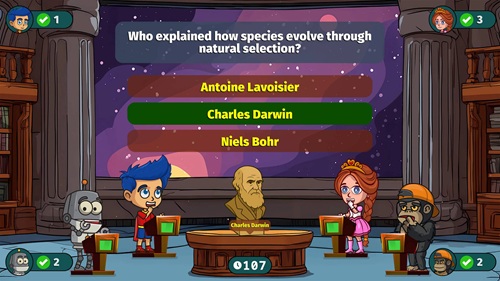
I do think that Educational Family Games is what it set out to be: a Mario Party-like with more minigames based on educational topics. Those minigames may not be to the same quality as Mario Party, but with a name like Educational Family Games I was happily surprised with what was presented. I can imagine playing each board with my son, exploring the different aspects of each (Ice Cream Land had a Monopoly theme with players buying the spaces they landed on), and laughing at the minigames. I do wish there were more options presented before and during the game, like controller selection or different accessibility controls, but that can be overlooked. I think Educational Family Games is a good video board game that is appropriate for all kids. Reading skill is needed of course, and the game is rated E for Everyone with an ESRB descriptor of Mild Fantasy Violence. –Jeff Orth






Discussion Area - Leave a Comment