
Unplugged: GamerDad Holiday Guide 2025
 Happy Holidays! After two decades of a GamerDad Unplugged Holiday Guide I think it’s finally time to say boardgaming has officially gone mainstream. There’s no better time to get (or get your friends and family) into the hobby than an extended holiday break. There are boardgames out there to meet up with almost any taste. Boardgames are timeless, just as good today as they will be years in the future, so a purchase today will still be serving you well into the future. As we at GamerDad have done for the past 20-odd years, it’s time for an annual rundown of recent boardgames well worth your time. Feel free to delve into some past year’s guides for 2024, 2023, 2022, or older as they’re still great candidates for your consideration. You might not find all these titles at your local mega-mart but many can be found online or in a friendly local game store. Some may argue $70+ boardgames (or more) are expensive, but compare that to video gaming (and where multiple copies are required for multiplayer play) and the economics of boardgaming shows their true value. For each game, I’ve provided the publisher (to help you find it), an approximate MSRP (you can probably find it lower), the number of players, the expected time for one game, and the manufacturer’s recommended ages. These age listings are often set for legal reasons and I would say most could easily be skewed lower for experienced younger gamers.
(Buy through this link and GamerDad gets a kickback…)
On with the show!
Kids Games
Games suitable for kids old enough to sit still and play, but contain enough interesting activity to entertain adults.
Bluey Hide & Seek Game (Moose Games – $15) 2+p 5min 3+ yrs (*there’s also Bingo figure version)
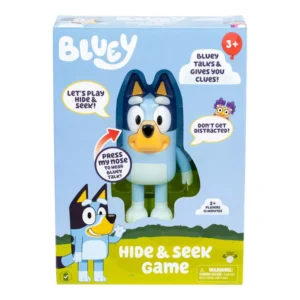 If I have to pick one game I’ve played the most all year it is the Bluey Hide & Seek Game. Sure, the Bluey Keepy Uppy Board Game is a hoot even for adults, but my daughter can not get enough of this Hide and Seek toy. Basically, you press Bluey’s nose and then hide her (she’s about 6 inches tall.) The player (or players) then must wander around the room in order to find where she’s hidden. When she’s found, press her nose again and you get to have a little Bluey’s Dad style dance-off. If that was it, it would be a fine game. What takes it over the top is that it also has a setting that talks while it’s hiding. Phrases like “I’m hiding really well!” “Don’t get distracted” or “Where’d they go” ring out to help a particularly younger child (or those a bit developmentally behind) find more devilish hiding places. I have no illusions that Bluey Hide & Seek will probably also be the #1 game of 2026.
Party Games
The more, the merrier! Party games can accommodate at least 6 players and, unlike some games, tend to be more fun with more players. If you’re only aware of Charades (a classic) or Trivial Pursuit (only fun for know-it-alls) checking out some of these more engaging games will be a real treat.
Brick Like This! (LEGO – $20 ) 2-8p 15min 7+ yrs
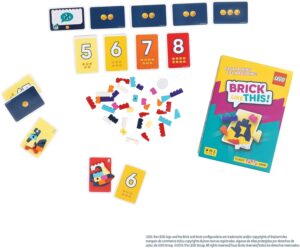 In Brick Like This! 1 to 4 sets of partners are attempting to build a specific shape with LEGOs. The trick is that only one person can see the shape card, and they must describe it while their partner builds. The shape-knower can describe shapes, colors, or whatever but they can’t point at or touch the LEGOs. In a multiplayer game it is a race. The first builder to complete their task flips over a timer and the rest of the players have until it runs out to finish their structure. While there are levels of difficulty for the shapes (using 5 to 8 pieces) players may also up the intensity of the game (or simply adjust difficulty for some players) by opting to take on a disadvantage (provided by a card) while completing their shape. These come in three levels – indicated by the number of coins on the back of the card. Challenges range from the simple (the instructor isn’t allowed to say numbers), medium challenges (builder must keep their fingers crossed, the instructor can only say “yes” and “no”), all the way up to hard challenges (the instructor cannot speak at all – no pointing or touching either, or the builder must keep their eyes closed or must build the model under the table.)
Family Games
As your family gets older, they’ll have more fun with games with a bit more “punch”. Games in this category are playable by most any age level (so even the young ones can participate) but have enough strategy so that the older players have a chance to use strategy to increase their chances of winning.
Nekojima (Friendly Skeleton – $40) 1-5p 20min 7+ yrs
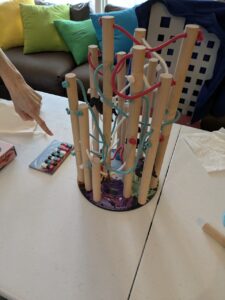 Nekojima has 1 to 5 players building up a set of high wire power lines throughout the city, making sure they don’t touch, even when burdened with the occasional cat. Players roll a die and pick a pair of wooden dowels attached by a string. The dowels are of varying lengths. Some are high, others low, often it is mixed. The dice determine which two of the four areas need to be connected by the towers. A colored cube is drawn to determine which dowels are used by the color of the string connecting them. When a black cube is drawn, a second cube is drawn to decide the rope color but then the player must also hang a cat token from any string of that same color. Not only must the wires never touch, but any hanging cat should not touch any wires either. Players can play competitively – with one loser who knocks things over, or cooperatively to see how high they can build. That may be quite high indeed as there is no rule against stacking new dowels on top of old ones, perhaps just to find some open air. This one has been a big hit in my more gaming-light, cat-crazy family.
Fast Factory (HABA – $20) 2-6p (two teams) 20min 8+ yrs
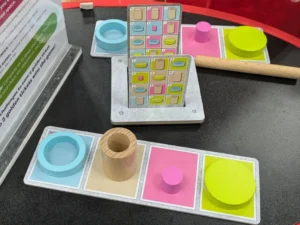 Fast Factory is a speed dexterity game for 2 players or teams. Players start with a set of items in front of them – a green disc, a pink cylinder, a blue ring, and a wooden cylinder that is hollow on one side. They interact in interesting ways – the blue ring goes around the wooden cylinder but matches the green disc while the pink cylinder will fit exactly into the hole-side of the wooden cylinder. These are each placed onto a playmat covered with four colored squares, matching the four pieces. When the competition starts, players race through the instruction sheet in order, placing the shown object onto the square that matches the background of the instruction. As pieces move around (and flip, in the case of the wooden cylinder), if you have to move a piece that is supporting other pieces, they all get moved. Once a player has completed the instruction set, they can flip over the instruction card to see if they did everything correctly. If their objects are in the same formation as the image on the card, they win. It’s a fun twist on the simultaneous speed-dexterity games.
Unmatched Adventures: Teenage Mutant Ninja Turtles (Restoration Games – $80) 1-4p 30min 9+ yrs
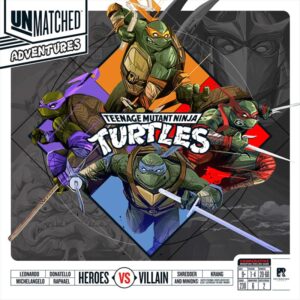 The second stand-alone game in the “Unmatched Adventures” line, where the Unmatched fighting system is repurposed into a cooperative battle game against one big enemy and its minions. Unmatched is a game where players maneuver their character(s) around a location-linked board, attacking and defending in a no-luck combat using a deck of cards unique to each character. Obviously, here players are able to take on the role of any of the four Ninja Turtles to take on Shredder or Krang (each played on one side of the double-sided board.) Shredder tends to throw lots of minions at the Turtles while Krang relies more on traps and other gadgets, and then there are the various minions always included in the mix. The enemies’ turns are governed by special action cards and a set targeting system to govern their movement and attacks. The bonus here is that all four of the heroes can also play in the regular combative Unmatched games AND the other Unmatched heroes can be plunked down into the cooperative version of Unmatched Adventures. Fans can think of it as a super-expansion (and a cost-effective one at that) while the rest of us can use the game as a good jumping-off point to the Unmatched game system. If the $80 price tag makes your eyes water, last year’s co-op game Unmatched Adventures: Tales to Amaze is the first co-op game in the series and looks like it’s running only $60. Note, any of the crazy number of denizens in the Unmatched system can be used in one of the cooperative games or in a 2 or 4 player deathmatch. The characters span the gambit including King Arthur, Shakespeare, Hamlet, Bigfoot, Nikola Tesla, as well as many of your favorite Marvel heroes. (Jurassic Park, anyone?)
Family Strategy
These are great games for most families – or a group of adults looking for a medium-weight game to play casually around the table to end an evening. These are a notch up in complexity kid’s or party games, but are simple enough for teens or preteens to enjoy.
Star Wars: Battle of Hoth (Days of Wonder – $60) 2-4p 30min 8+ yrs
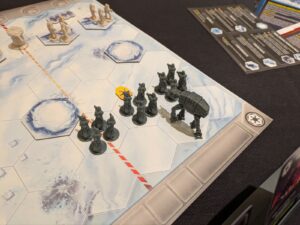 Star Wars: Battle of Hoth is another take on the Memoir ‘44 system, a very approachable wargame for a wide range of WWII battles. Players fight over a game board divided into left, right, and center sections. On a turn, a player chooses a card from their hand in order to “activate” one or more units on the board. An activated unit will move and then attack. These played cards typically allow a player to move X units in a specific section (left/right/center) or possible X number of a type of unit. In this way, players are not just free to activate the same unit over and over again. Managing one’s options in hand is almost as important as picking the right units to attack. In addition to the theme and very cool miniatures, Battle for Hoth keeps the main parts of Memoir ‘44 but creates a faster moving, shorter game. This means a single battle can be easily played in less than an hour, possibly even 30 minutes if the players are more experienced. With 4 players, each team has their own set of cards and alternate turns. While things can get a little tight with 4 players, this might be a great way to play with a younger or less experienced partner as you can discuss strategy amongst each other. Although the game is clearly set up along the lines of the Star Wars battle on the planet of Hoth, the game comes with 16 different scenarios setups, providing some variation. A large, 18th scenario is also included which requires two copies of the game (presumably you might have a friend with the game…) In a slight change from Memoir ‘44, players can shuffle a leader (set of 3 cards) into their deck which provides fairly powerful, unique effects. Finally, there are two mini-campaign booklets included. Each is a set of four-ish sequential battles where the next battle setup is adjusted based on the previous result. Did you lose the last battle as the Empire? Maybe Darth Vader is added to your deck – your failure has required him to show up to “take care of things personally.”
Pirates of Maracaibo (Capstone Games – $50) 1-4p 60min 12+ yrs
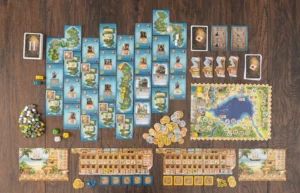 A shorter, friendlier version of the more complicated Maracaibo, this game has players sailing their pirate ship across a board of tiles left-to-right as they hire people, improve their boat, and collect treasures. People and boat improvements give a player better and more flexible abilities while collecting treasures is a big way to get points. Players get to choose how far they will travel each round (1 to 3 spaces.) Landing on a space (tile) gives a player that action/reward and then the tile is replaced with a new, slightly more powerful one. When one player makes it all the way across the board, everyone resets to the left hand side and players go across again. After three trips across the final scoring is calculated. Since players choose their movement, they can decide whether they want to pick and choose their best spots or possibly take a slightly less optimal location in order to race ahead. Almost everything players do can score some points at the end but big sources of points come from meeting goal cards drawn during the game (found at specific locations – but then you’re not gaining resources or upgrades that turn) as collecting the treasures. There is a cool mechanic for treasures, it is common to upgrade one’s ability to collect specific types of treasures. However, the point value of each treasure type decreases the more that treasure is collected – giving players another thing to balance as they go along in the game. There’s a single player mode played against a dummy player controlled by a deck of decision cards. It’s a great way to teach oneself the game and a decent solo experience as well.
Suna Valo (Capstone Games – $50) 1-2p 60min 14+ yrs
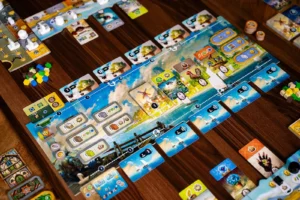 Suna Valo is a unique economic engine-building game specifically for two players. Players accumulate cards each round to put into their personal tableau. A player’s tableau has several columns, each with a special ability. Most provide various types of resources (as well as limited storage places for said resources.) Two others allow spending the resources by shipping them (first column) to satisfy contracts (second column) for specific resource combinations. The unique part of the game comes from how cards are acquired. It is a two step process. At the end of their turn a player chooses a card (from the middle of the board or drawn off the deck) and then place it in front of their play area. That player then chooses exactly what price they want to pay and put it on the card. On the opponent’s turn, they have the option of buying the card from the other player, paying the set price. With the card’s “owner” collecting their assigned resources back as well as the resources paid by their opponent. The game has players alternating turns as they go through three decks of cards, representing 3 eras, with more powerful cards appearing in later eras. The engine-building part of the game comes when playing cards to one’s tableau. When placing a card, every card in that column will trigger. Thus, having lots of cards in the same column means a player will gain lots of things. However, they are then putting fewer cards in the other columns and are going to be far less flexible in their options. In this way, players accumulate cards, gain resources, and spend them to fulfill contracts. Fulfilling contracts will also open up special upgrades on a player’s board (which borders their card tableau) which enhance a player’s options, flexibility, or straight-up provide more points at the end of the game. The game has a pleasing economic snowball effect as the game progresses and the unique way players can purchase their opponent’s cards is a great way to provide some lightweight player interaction without straight-up diminishing an opponent’s already-built engine.
Serious Strategy
Just a bit more complex and requiring a bit more planning, these strategy games are great for an evening of gaming. They may be a bit much for someone who is primarily there for the social element, but this year’s crop isn’t going to overwhelm the typical boardgame player. None of these are nowhere near as complex as some past years’ “serious strategy” recommendations, but are still best played by people willing to put up with a few rules in order to find a game that has substance.
SETI: Search for Extraterrestrial Intelligence (Czech Games Edition – $70) 1-4p 120min 14+ yrs
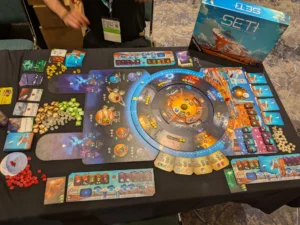 SETI has players looking for intelligence out there in the deepness of space. Rather than lean into a sci-fi future, it is set more in the current-day. Players take turns launching probes, putting them next to planets, scanning with telescopes, etc… Each action interacts with the spinning board in some way. Each time a player gets an upgrade to their abilities, the solar system board rotates, which brings different planets closer or farther to others. Players semi-cooperate to accumulate resources (money, cards, and other resources) Players take actions by spending a hand of cards and the round ends when everyone runs out of cards. As is traditional in this type of games, players can pursue upgrades to make their future actions more efficient while still trying to earn points to win the game. The endgame involves interacting with two encounters with intelligence (maybe a suspicious asteroid or far off radio signal) – providing new, powerful cards as well as juicy point targets. Each intelligence has its own mechanic to the game and two are chosen at random from a possible 5 types. The types chosen are only revealed when triggered towards the end of the game. When the game comes to a close, players also score according to goal cards that they themselves chose during the course of the game. A player further ahead on points in the middle of the game gets first crack at which goals they pursue but that may mean they have spent less effort getting their own point-generating machinery going.
Star Trek: Captain’s Chair (WizKids – $60) 1-2p 90min 14+ (expansion $30)
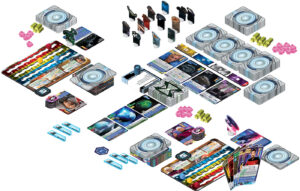 Star Trek: Captain’s Chair is an asymmetric deck building game. The game is asymmetric because every player has fairly different abilities, which tends to make players favor one way of scoring over another. The deck-building part has players using a deck of cards to accomplish actions, some of which entail buying additional (more powerful) cards to put in ones’ deck for future rounds. Gameplay focuses around playing ships, crew members, and locations to one’s personal or the central area in order to score points or increase along the resource or influence tracks – unlocking additional abilities and/or points. One key component of the game has players putting ships and crew on location cards in order to claim them for one-time benefits or scoring opportunities. The game has a bit of a steep learning curve (thus the Serious Strategy categorization) primarily due to the many different keywords and icons on the cards. Player powers are based around their primary captain chosen at the start from among Picard, Sisko, Burnham, Koloth, Sela, and Thy’lek Shran. As mentioned, each has their own style of play. Captain’s Chair particularly stands out as a solo endeavor as the “AI opponent” is chosen from the unused captains each of which have their own style of game play in the solo game. It has been popular enough to spawn two upcoming expansions. Star Trek: Captain’s Chair – To Boldly Go is a new stand-alone version with 6 new captains (including Kirk) which can also be mixed and matched with the first game. Star Trek: Captain’s Chair – Second Contact is an expansion that needs either of the base games and includes 3 new captains, including Pike and Freeman (from the animated Star Trek: Lower Decks.)
Adventure Games
Boardgames with a strong role-playing look and feel continue to flourish in the boardgame world. Perfect for gamers who want that role-playing feel without having to dedicate the dozens of hours needed to play traditional pencil and paper RPGs. These games run the gamut from simple and inexpensive to detailed and very expensive. Here is a sample cross-section.
The Elder Scrolls: Betrayal of the Second Era (Chip Theory Games – $225) 1-4p 150min 14+
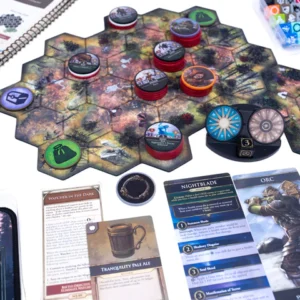 Elder Scrolls: Betrayal is a grand adventure game with players journeying around a large map broken into regions, as is found in the videogame The Elder Scrolls. In practice, the game is meant to be played in three sessions. The first two sessions have players going on a specific quest in a region, determined by their chosen guild (guilds are important in the videogame). The final session has players fighting some climactic battle with their now-legendary characters. The game is huge, with six different regions to explore – each region has its own flavor including unique backstory, items that can be found in shops, quests (both major and minor), monsters, etc.. With six guilds available over six regions that means there are well over 36 main quests to explore. What I love about the game is that it provides an excellent feeling of character progression. Many games of this type are built to play over dozens of sessions, granting a player incremental benefits after each play. Here, players will gain new abilities and grow in power in every session giving that great dopamine hit of ending the night far more powerful than when you started. Player abilities are triggered using dice. All the attacks and most of the special skills are represented by dice – color coded by the type of skill used. A key part of character growth is buying new dice to put on your player mat. In combat, dice are rolled and then put in a waiting queue to be regathered at the start of the next turn. Players can push things along and roll more dice for more attacks but that also means (because of the queue) they will not be getting all of their dice back the next turn. It’s a pricey game, but this is a Chip Theory Games project and the boardgame bits show their commitment to luxuriousness. Each player mat (and all the map tiles) are made of neoprene mats, the player and enemy tokens are hefty poker chips, and all the cards are waterproof PVC – the running gag is that you can chuck everything in the box (except for the rulebooks) into the tub without messing something up.
Kinfire Delve: Vainglory’s Grotto, Kinfire Delve: Scorn’s Stockade, Kinfire Delve: Callous’ Lab (Incredible Dream Studios – $25) 1-2p 60min 14+
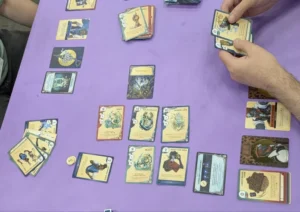 Kinfire Delve is a cooperative (or solo) card game in the dungeon crawling genre. The game is card-based. The big bad boss has a deck of challenge cards (50+) that need defeating before you can take on the BBB more directly. Players attempt one of four challenges available on their turn by playing cards matching a challenge and rolling dice. Success means progress tokens get added to the challenge, put on enough and gain the rewards – sometimes even discarding unseen challenge cards! Fail to defeat the challenge in time and you’ll face a loss of health or cards. Players can use cards in hand to help others during their turn, but if you want to draw a new hand of cards, players must also take an exhaustion card which often triggers nasty ongoing effects that can drag you down and lose you the game. The game comes in three releases, each release containing two characters and a big bad guy to defeat. The game can be played solo or cooperatively, and characters from several releases can combine to increase the player count. Vainglory’s Grotto was the first in the Kinfire Delve line, it included a defensive bruiser and a high-damage lady with deadly nails. Callous’ Lab has players attacking challenge cards arrayed around the central Callous personage. The two heroes are a fire-wielding healer/scholastic character and a bow-person that “shoots from afar” but also has ways of avoiding problems entirely. Scorn’s stockade has a bardic healer, good at drawing cards with some dice reroll powers, and the other character messes with progress tokens and the ability to ignore penalties and health loss in some situations. It’s a pretty quick game as far as adventure-themed ones go, but is also far cheaper than any others in the list.
Tales of the Arthurian Knights (WizKids – $80) 1-4p 150min 12+
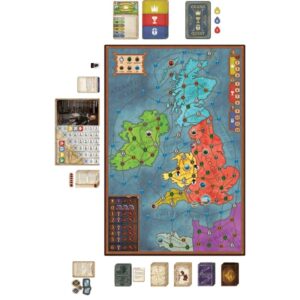 A sequel to the narrative-driven Tales of the Arabian Nights, Arthurian Knights once again has players exploring a large world with story-based experiences mined from a 300+ page book of tales, lore, and encounters. Characters move about the map board, triggering events and encounters which are keyed off of a 4 digit code used as a reference in the lore book. Players can grow in stature and skill with four main attribute categories broken down into three sub-categories each. For example: Piety, Wisdom, and Magic are all in the same category. It can be a lengthy game, clocking in at around 45 minutes per player (it’s a 1-4 player game) but the game does allow for shorter games. The game typically lasts through 3 ages but can be played through just one or two.
Dungeons & Dragons – Starter Set: Heroes of the Borderlands (Wizards of the Coast – $50) 3-5p 90+min 12+yrs
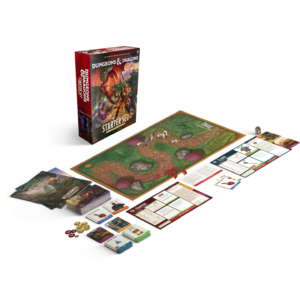 It’s almost inappropriate to mention adventure games without harkening back to their roots of actual role-playing games. Dungeons & Dragons, the grand-daddy of them all has had some ups and downs the past couple of years but this fall has put out one of the best starter sets yet for the D&D rules. This new one appears alongside the most recent rules refresh from last year (officially “2024 rules” but some liken it to 5.5th edition.) Heroes of the Borderlands turns a typical beginner D&D game almost into a boardgame. In addition to quick-start rules (as well as a full set of rules – up to level 3 anyway) and a series of 3 adventures there are all sorts of bonus goodies to help on-board players to the D&D rules set. Over 200 cards, maps, and monster/player tokens for said maps. The cards list character abilities (race/class/background/spells/magic items) for easy player reference during the game, keeping the most important bits about a player’s abilities front and center. Other cards are a reference more for the dungeon master and represent NPCs or monsters the players will meet. One standout feature of the beginner set are the three included adventures. Each adventure speaks to a different style of role-play. Players start out headed through the wilderness while they explore the area near a small town. This exploration phase also serves as a bit of a tutorial to the D&D game. After that, players can chill out in the main settlement in the story, encountering lots of role-playing opportunities and/or head out to the nearby Caves of Chaos to dip into a much more combat-oriented style of play. After all three adventures, the gaming group should have a handle on the kinds of stories they prefer to create. The box also includes a digital code for all the box’s bits on the D&D Beyond web site, which lets players use the materials in the box in an online setting. (Note, you can even buy just a digital version of the box from the D&D Beyond web site.) If $50 for a “starter set” is a bit too steep, look around for the last introductory D&D set produced, the Dungeons and Dragons Essentials Kit. It runs around $20 and is a steal for all the included content. It also has helpful cards, starting characters, dice, an adventure that slowly ramps up in complexity. It brings player characters up to level 6. Early versions of the box set also included a code for the D&D Beyond digital edition, including free-to-download companion adventures that have everything needed to get players all the way up to level 13. Buying the $15 “Dragons of IceSpire Peak” adventure on D&D Beyond now gives you digital versions of everything – including the extra adventures. (Still a decent deal…) Opinions online seem to think the Essentials Kit is a little bit more effort for a DM (game moderator) while this new starter set improves the on-boarding for everyone involved. (There’s more helpful “stuff” and all the game information is laid out in a friendlier, more digestible manner.) Of course, fans of Netflix’s Stranger Things may want to check out Welcome to the Hellfire Club – a Stranger Things inspired starter set that allows players to play the D&D game that is going on within the Stranger Things series…
Other RPGs
Brand-name Dungeons & Dragons is no longer the only RPG on the block, lots of smaller publishers are carving their own niche in the world. Some are filling in gaps in the normal 5th edition D&D rules. I’ve always loved the books of monsters from Kobold Press and Free League Publishing has a pretty good line of stuff based around the Lord of the Rings. Both publishers have also created their own rules set (there was some bad blood about the official D&D rules awhile back) with Kobold Press creating Tales of the Valiant (slightly more complex than vanilla D&D) and a new and Free League Publishing making The One Ring set of fantasy rules – also set in the Lord of the Rings, of course. Further afield is the new RiverBank RPG (also by Kobold Press) that has players essentially taking on the roles of animal characters like those found in the Frog and Toad children’s books – complete with a similar art-vibe.
There are a lot of off-brand options even staying within the official 5th Edition rules set. Obojima Tales from the Tall Grass from 1985 games lets players play in a very Japanese Anime / Studio Ghibli style world. The Crooked Moon from Avantris Entertainment specializes in Gothic/folk horror based stories. Hit Point Press has a cool book entirely about flower-based dragons – The Field Guide To Floral Dragons. For those DMs who find it hard to get the creative juices flowing, Roll & Play Press have two volumes of One-Shot Wonders – books containing 100 different 2-page adventures playable in around 3 hours.
Stockings
Got a bit of space left in your sock over the fireplace? Here’s a great small game that you might be able to cram into the toe, or at least it’s easy on the pocketbook… Note that Brick Like This and Kinfire Delve mentioned above are also on the cheaper side of things…
The Lord of the Rings: The Fellowship of the Ring – Trick-Taking Game (Office Dog – $27) 1-4p 20min 10+ yrs
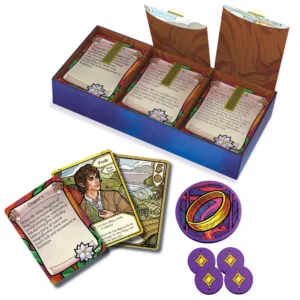 Cooperative trick-takers appeared on the scene just a few years ago. It’s bridge, euchre, or spades but with challenges that must be overcome by everyone working together. This could be something like everyone needs to take a “7” card during a round, one person can’t take a trick, the blue 7 must be played before the red 9, etc… In this Lord of the Rings themed cooperative trick taker, players play through a series of 18 games (hands) that follow the storyline of the book, typically progressing in complexity as the game goes on. (You could go through the games in any order or hop around, but most players will choose to stay with the storyline.) During a hand, each player takes the role of one of the key players in the book (Frodo, Gandalf, Sam, Pippin, etc…) which gives that player some sort of special requirement that must be met during a round to progress to the next one. Frodo, for example, needs to collect ring cards while Pippin is lazy and is hoping to take as few as possible. There are 37 cards in the game and whoever receives The One Ring card becomes Frodo. (The One Ring is the only trump card but it can’t be led until someone plays an off-suit.) Other players then choose characters depending on the situation (their hand, and the round.) It’s best with 3 or 4 players. A two player game adds in a third, dummy hand that is partly face up and part face-down. The dummy hand is also given a character and one human player will choose from the available cards when it is time to play. The solitaire version requires one to play four face-up hands at the same time but only some of the cards are eligible to be played at any given moment.
Dragons of Etchinstone (Chip Theory Games – $15) 1p 25min 8+ yrs
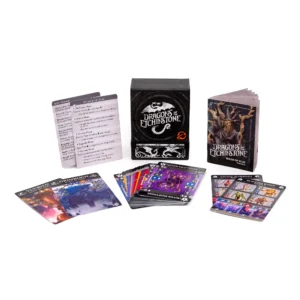 Dragons of Etchinstone is a tiny solo adventure-type game that can be played while holding a single stack of cards in your hands. Cards have four values (front/back, top/bottom.) One card represents the trials while the “skill” cards in front are used to overcome those trials. A successful completion allows players to rotate and/or flip their skill cards to upgrade them when encountered again. Taking damage from a conflict downgrades card abilities. After several “encounters” players must use all their (hopefully upgraded) cards in one final push against the end-game boss (there are several to choose from.) Designed by the person who created “Gloomholdin’” (a similar game that tried to fit the mega-adventure game Gloomhaven into just a hand of cards…) It has a very similar feel and manages to pull off an adventure-y type game that can be kept in a pocket and played with one hand. (OK, two since it’s hard to flip a card while holding the deck with the same hand.) The game was initially crowdfunded and as a lark, a cat & dog version (same statistics but cat & dog art from backers) was created entitled “Dragons of Etchinstone: Felines of Fetchin’ Bone” where skill cards are dogs and the big bad guys are cats.
A Carnivore Did It! (Horrible Guild – $18) 1-5p 20min 8+ yrs
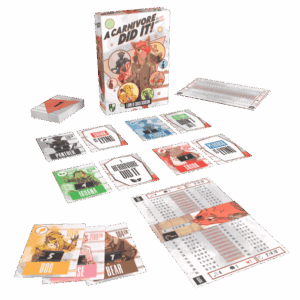 A Carnivore Did It! Is a very thinky sort of puzzle card game of deductions. As a group, players are trying to figure out the culprit of a crime based on a set of clues. The culprits are laid out on the table along with their statement to the investigators. It could be “Shark is telling the truth.” or “A carnivore did it”, etc… Players must work together to figure out who did the crime by putting together all the statements. Some of the animals might even be lying! It may not be too bad when you’re dealing with a few (mostly) truthful animals, but can you handle up to 7 animals with their own conditional statements? There are two thousand ways to set up the game, each resolving in a single correct solution. The game also has a sort of min-campaign that links several cases in succession and scores players on how much time it takes players to solve them all. This game is a thinker, but would shine for the right audience.
Seeker Chronicles (Wise Wizard Games – $15) 2p 30min 13+ yrs
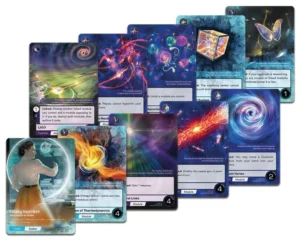 With a bit of a heavy-handed “science” theme, Seeker Chronicles has players playing through their personal deck of cards a total of three times. The first player to cycle through all 3 times wins the game. Players start the game by making a deck of 3 Seekers (9 famous scientists like Feynmann, Curie, Tesla, etc…) and 30 Modules (other resource and action cards.) Each Seeker also comes with three specially-themed cards which a player earns when they Awaken that Seeker. Labeled by the scientific method, the three cycles through a player’s deck are called Hypothesis, Evidence, and Conclusion. The first player to finish their Conclusion, wins. On their turn, players use their Module cards to create resources and move them around, often attaching them to one of their Seeker cards. When a player’s first Seeker is powered up to 7 power, they “Awaken” and that player can bring another Seeker (and its abilities) into play. The main way to score points comes through the Research phase. After playing out one’s cards, the opposing player is allowed to possibly respond through their own plays, then the players compare the powers of their Seekers. If the active player has a stronger Seeker, they get to discard the difference in strength from their draw deck – getting that much closer to a win. Some of the “fun” decisions to be made in the game involve deciding when (during a turn or save it as a surprise on your opponent’s turn?) and how to use a card (set it aside for future resources or commit it to a Seeker to power them up, but lose that resource generation..) Each of the nine Seekers fall into one of three categories: Cosmos – high cost, high powered cards; Order – defensive, opponent limiting cards; and Quantum – various tricky cards that bend the rules. Players can mix and match their Seekers and other cards to match the play style they like.
Solo
Whether it’s hard to find an opponent, or just hard to get out of the house, the realm of solo gaming (playing a boardgame solo) has been on the rise. Traditionally the realm of a dedicated wargamer, there is now a large breadth of solo games available. Many of the games in this year’s guide have solo modes.
Rather than list new games here, I decided to give a broad overview of all the games listed to have a 1 player option. Dragons of Etchinstone, of course, is entirely solo. A few of the other games stand out as good solo fare, Star Trek: Captain’s chair is just as good solo as a 2 player game since the game will have an entirely different feel depending on the captain chosen and the captain chosen to play against. Elder Scrolls is also great solo, often it is easier to just solo it than try to get a gang of 3 or 4 together in 3 separate settings. However, it tends to be easier and I think a bit more pleasing of a story arc if the solo player takes control of at least two different characters. Pirates of Maracaibo has a pretty good solo mode that is also excellent as a way to learn the game on one’s own. Unmatched Adventures is decent solo but again, best played using at least two player characters. Several other games in the bunch list solo play as an option: A Carnivore Did It and Nekojima are both sort of puzzle games so don’t change much without other players (although I do like company). However, I didn’t find SETI very compelling as a solo experience, Suna Valo loses something solo as you don’t have that direct buying/selling conflict, and the Fellowship of the Ring Trick Taker wasn’t very satisfying solo (or, for the most part even with 2 players.) I will say that in almost every case I found playing a round or two for the “solo” game helped me learn the rules so that I was better prepared to explain them to other players. To cover all my bases, I must point out that I think a solo game of Bluey Hide and Seek is probably not going to go over all that well. (OK, OK, you could just push her nose button and do the celebration dance – that’s always fun…)
Expansions:
If you already have favorite games in your collection, you may be pleasantly surprised to find there are expansions available to breathe new life into old favorites. Here are a few I like that expand some of the meatier games I’ve recommended in the past.
Unmatched has a crazy number of releases out there that provide additional characters and maps to play on. They usually appear in sets of 2 or 4 but both types of expansions include a map on which to play the competitive game. As mentioned, all the characters are able to be brought into the Unmatched Adventures co-op mode.
SETI: Space Agencies is a brand new expansion for SETI that I have not yet gotten to try. It adds in some new aliens (to choose from when you pick two during setup) but also has mechanisms to “jump start” the game a little bit by handing out some initial resources, providing players with unique powers, etc… While I don’t think the base game will need extra content anytime soon, trimming a little bit of time off the game would be welcome.
If the Elder Scrolls didn’t destroy your pocketbook, there’s a Valenwood expansion that adds yet another region (and its quests, towns, encounters, and monsters) to explore along with two new skill lines of dice and two new character classes to choose from. I expect to hit it up once I’ve explored the base game some more…
Not mentioned this year, but Heroscape is an amazing lightweight miniatures game that has regularly seen coverage in the annual holiday guide. Because of the buildable hexagonal terrain and the cool miniatures I do not think there is another game out there that is more attractive to a teenage boy. (Not that others, especially adults like myself won’t find something to love.) The game was relaunched last year in two starter type boxes, one big and one smaller. Since that time there have been many, many expansions of new characters to use. Some of my recent favorites into giants who are archers, able to shoot insanely long distances, or death robots with chain whips who run around on spherical wheels. My son is partial to the army of polar bear gunsmiths.
Conclusions
No matter what toys and presents the holidays bring, be sure to keep time in your schedule for playing with friends and family. While the games here come highly recommended to provide fun for a wide range of players, there are plenty other choices available. Ask your local game store, a boardgaming friend, or check some of our past recommendations.
*Disclaimer, many (but not all) of these games were provided by the publishers for review purposes. Of course, plenty others were provided who didn’t make the cut.






Discussion Area - Leave a Comment